
Bringing Flame Serving Close to Standalone vLLM
How prefix placement, batching, and an asynchronous adapter brought Flame within 1 percent of standalone vLLM median throughput on two B200 GPUs.
Read More →
XFLOPS helps enterprises build AI applications with open tools, frameworks, and best practices. Flame is the community's core project: a distributed engine for secure, cost-effective, and high-performance elastic AI workloads.
Scale AI workloads dynamically based on demand with runtime-aware scheduling and resource optimization.
Use session-based access, isolated runtime environments, and secure component communication for elastic workloads.
Optimize resource utilization and workload distribution so AI systems can run efficiently at scale.
Support varied infrastructure, including CPU, GPU, and accelerator-backed environments.
Improve throughput and roundtrip time for task-heavy AI systems through distributed execution.
Build portable runtime infrastructure for cloud, on-premise, and hybrid deployments.
Flame is the core XFLOPS project for elastic AI workloads. It provides the distributed runtime mechanisms behind sessions, task scheduling, executor reuse, object caching, and secure service integration for agents, reinforcement learning, generated-code execution, and more.
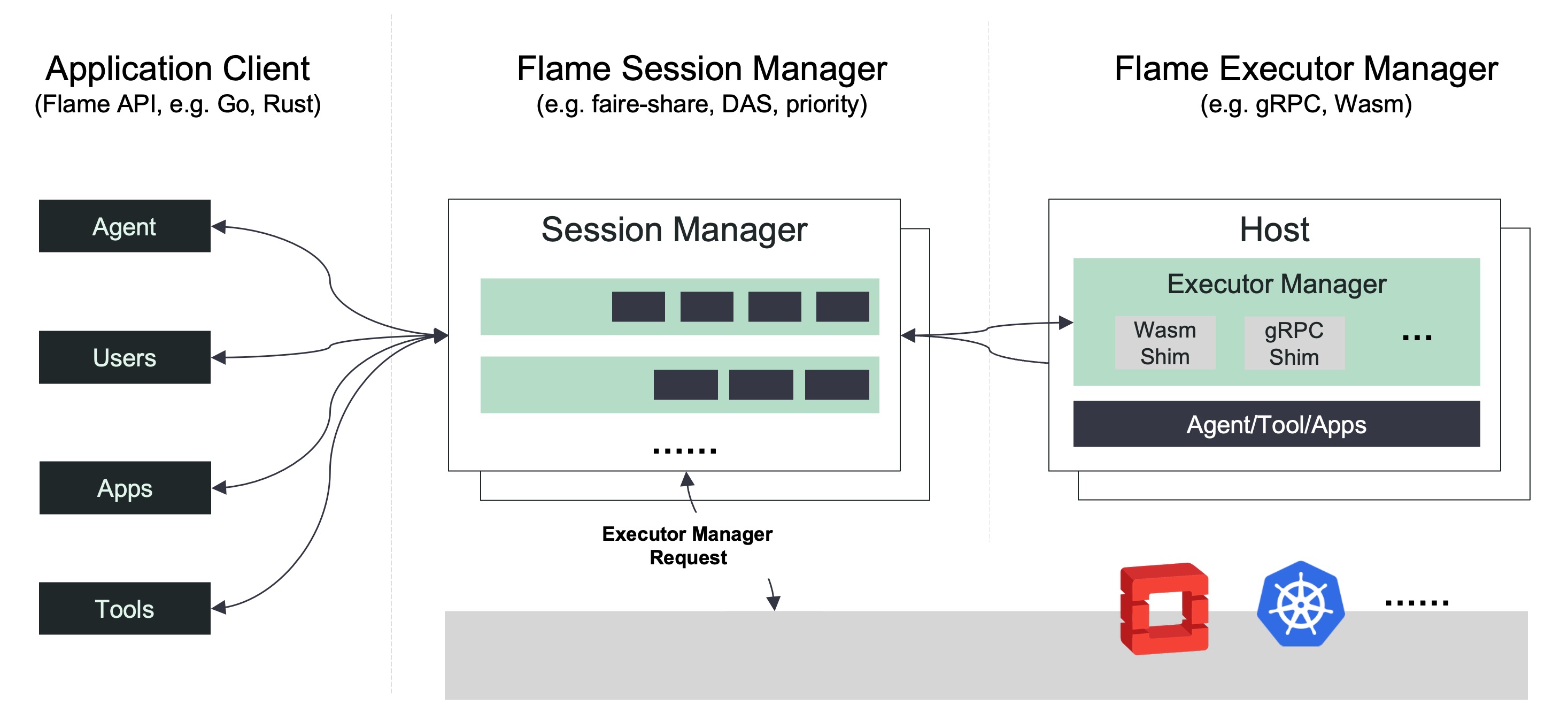
The three latest technical walkthroughs from the XFLOPS community and Flame project. Explore Flame serving benchmarks against standalone vLLM, Search-R1 training, and the distributed runtime behind these workloads.
How prefix placement, batching, and an asynchronous adapter brought Flame within 1 percent of standalone vLLM median throughput on two B200 GPUs.
Read More →
How Flame simplifies Search-R1 training with Python services, warm GPU executors, elastic rollouts, gang-scheduled trainers, and incremental weight transfer, demonstrated in a 100-step run.
Read More →
Flame v0.6 adds Runner, object cache, and install tooling for elastic jobs such as agents, RL, and crawlers. Batch jobs stay with Volcano; workflow jobs are not covered yet.
Read More →