
TorchRL DQN with Flame App and Sharded Replay
This post reviews the TorchRL DQN example in examples/rl/torchrl_dqn, then summarizes one sharded-replay test on an Apple M4 MacBook Pro using a Podman-backed Flame cluster.
The timings below are from the original Runner-based run. The architecture description follows the current App example; no new benchmark is claimed.
The example adapts a conventional TorchRL DQN loop to Flame App. The learner remains local. Flame distributes rollout collection, stores replay data through a TorchRL-compatible storage layer backed by Flame objects, and exposes a replay sampler as an App service.
Summary
| Item | Finding |
|---|---|
| Artifact | TorchRL DQN training on discrete Gymnasium environments using Flame App collectors and Flame-backed TorchRL replay buffers. |
| Main pattern | CollectorService -> ReplayBuffer(FlameObjectStorage) shards -> ReplaySamplerService -> DQNLoss -> local optimizer. |
| Replay modes | simple uses one shared replay buffer; sharded creates multiple object-backed replay buffers and distributes collector writes across them. |
| Test environment | Host: Apple M4 MacBook Pro, 8 CPU cores, 24 GB unified memory. VM: Podman Machine, 5 vCPU, 8 GB RAM. Flame on Podman Compose: 1 FSM, 3 FEM, 1 FOC. |
| Workload measured | CartPole-v1, 20 iterations, 4 collections per iteration, 100 frames per collection, 8000 total frames, --replay sharded --replay-shards 4 --sample-work 4096. |
| Primary comparison | --sample-parallelism 4 completed in 10.16s at 787.3 frames/sec; --sample-parallelism 1 completed in 16.27s at 491.8 frames/sec. |
| Interpretation | Under this synthetic sampling-heavy workload, four-way sharded sampling reduced sample time from 8.415s to 2.301s and increased overall throughput by about 60.1%. |
Scope
The implementation under review consists of the following upstream files:
| File | Role |
|---|---|
main.py |
CLI, distributed training loop, local training loop, metrics, and sampling plan. |
collector.py |
Stateful rollout worker used by the App collector service. |
distributed.py |
Initializes the app and declares collector and sampler services. |
replay_buffer.py |
TorchRL storage implementations, Flame object-backed replay storage, local replay storage, and sharding helpers. |
model.py |
Environment inspection, Q-value policy construction, TorchRL DQNLoss, and transition conversion helpers. |
pyproject.toml |
Runtime dependencies: Gymnasium, TensorDict, PyTorch, and TorchRL. |
The example is a DQN integration and data-path benchmark vehicle. It should not be read as a production DQN recipe or as a reward-quality study. The run uses CartPole-v1 and intentionally adds synthetic sampling work so replay sampling becomes visible in wall-clock timing.
System architecture
The training loop keeps the learner local and distributes the work that naturally fans out:
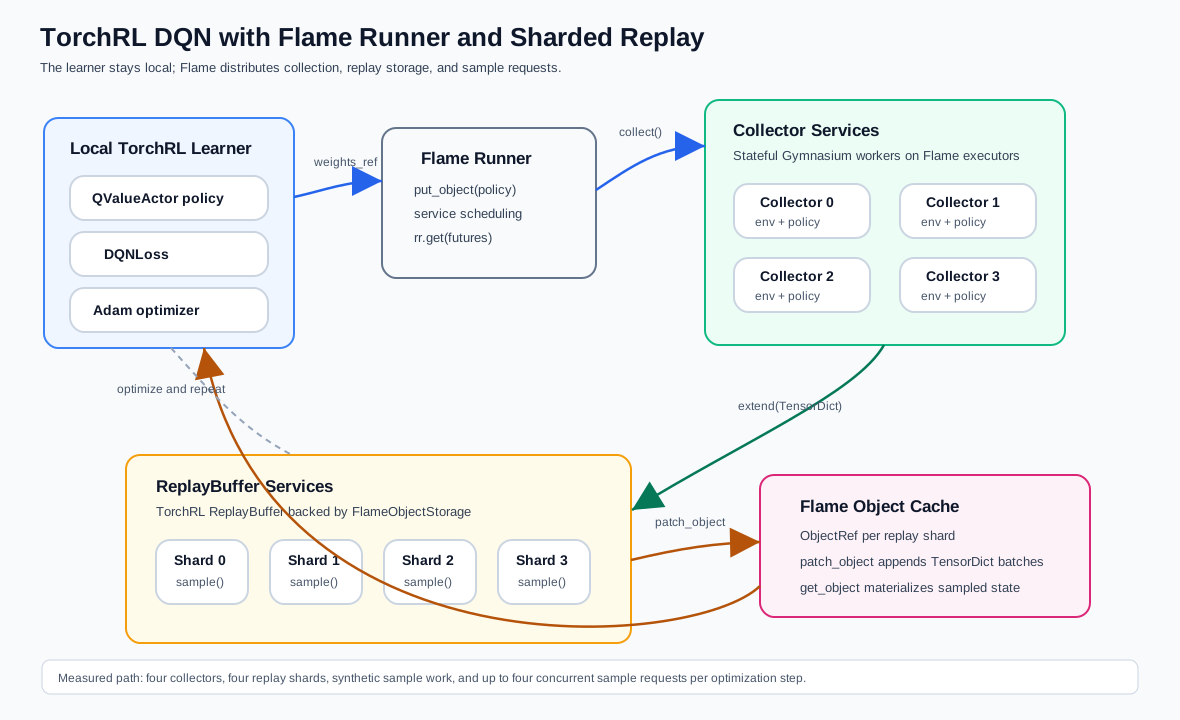
At a high level, the learner publishes policy weights through app.put(), Flame schedules CollectorService calls, collectors write TensorDict transition batches into sharded replay buffers, and the learner calls ReplaySamplerService before running the local DQNLoss and optimizer step.
The collector is stateful. Each service instance owns a Gymnasium environment and a policy object, loads the latest learner weights for each collection call, steps the environment, and writes a TensorDict transition batch into the replay buffer.
The replay buffer remains a TorchRL ReplayBuffer from the learner’s point of view. The important difference is its storage:
| Storage | Location | Purpose |
|---|---|---|
FlameObjectStorage |
Flame object cache | Stores TensorDict batches behind an object reference and appends new batches through Flame object patches. |
LocalObjectStorage |
In-process Python object | Provides a local comparison path with the same append-oriented semantics. |
This keeps the TorchRL training surface recognizable while allowing Flame to manage remote collection, shared object state, and service-level sample parallelism.
Replay modes
The example exposes two distributed replay layouts:
| Mode | Behavior |
|---|---|
--replay simple |
Creates one ReplayBuffer(FlameObjectStorage) and samples it through ReplaySamplerService. This is the baseline distributed replay mode. |
--replay sharded |
Creates multiple object-backed replay buffers, spreads collector writes across shards, and samples shards through ReplaySamplerService. |
The sharded mode is the relevant mode for the measurement here. With --replay-shards 4, collector writes are distributed across four Flame-backed replay buffers. With --sample-parallelism 4, the learner sends four sample requests per optimization step, each targeting a shard selected by the sampling plan.
The --sample-work flag adds CPU work inside the storage get() path used by TorchRL sampling. It is synthetic by design. It models replay operations that are common in larger RL systems, such as decompression, frame stacking, sequence assembly, or augmentation. Without this extra work, CartPole-v1 is too small for replay sampling to dominate.
Reproduction procedure
Start a Flame cluster, open the console container, and run the example from the Flame repository checkout:
docker compose exec -it flame-console /bin/bash
cd /opt/examples/rl/torchrl_dqn
Four-way sample run:
uv run main.py \
  --replay sharded \
  --replay-shards 4 \
  --sample-work 4096 \
  --sample-parallelism 4
Single-sample-request comparison:
uv run main.py \
  --replay sharded \
  --replay-shards 4 \
  --sample-work 4096 \
  --sample-parallelism 1
Relevant default workload parameters for both commands:
| Parameter | Value |
|---|---|
| Environment | CartPole-v1 |
| Iterations | 20 |
| Collections per iteration | 4 |
| Frames per collection | 100 |
| Total frames | 8000 |
| Batch size | 64 |
| Replay buffer size | 10000 |
| Optimizer steps per iteration | 1 |
| Target update tau | 0.05 |
| Epsilon schedule | 0.200 to 0.020 |
Test environment
All measurements below come from one local Mac setup:
| Component | Configuration |
|---|---|
| Host | Apple M4 MacBook Pro |
| Host CPU / memory | 8 CPU cores, 24 GB unified memory |
| Container VM | Podman Machine |
| VM sizing | 5 vCPU, 8 GB RAM |
| Flame deployment | Podman Compose |
| Flame services | 1 FSM, 3 FEM, 1 FOC |
This is a same-machine, VM-contained test environment. It is useful for validating behavior and relative timing under constrained resources, but it is not a bare-metal Linux cluster or a datacenter benchmark.
Results
Summary
| Sample parallelism | Total time | Total frames | Throughput | Final loss |
|---|---|---|---|---|
| 4 | 10.16s | 8000 | 787.3 frames/sec | 0.4962 |
| 1 | 16.27s | 8000 | 491.8 frames/sec | 0.4705 |
Throughput improvement from --sample-parallelism 1 to --sample-parallelism 4:
Total wall-clock reduction:
\[\frac{16.27 - 10.16}{16.27} \approx 37.6\%\]Timing breakdown
| Phase | Parallelism 4 | Parallelism 1 | Change |
|---|---|---|---|
| Collect | 7.607s total, 0.380s/iter | 7.606s total, 0.380s/iter | No material change |
| State | 0.053s total, 0.003s/iter | 0.054s total, 0.003s/iter | No material change |
| Sample | 2.301s total, 0.115s/iter | 8.415s total, 0.421s/iter | 72.7% lower sample time |
| Optimize | 0.089s total, 0.004s/iter | 0.108s total, 0.005s/iter | Small relative to run time |
| Iteration | 10.072s total, 0.504s/iter | 16.203s total, 0.810s/iter | 37.8% lower iteration time |
The timing breakdown is the main result. Collection time is essentially identical in both runs, which means the improvement is not coming from faster environment stepping. The difference is concentrated in replay sampling: four-way sampling completed the sample phase in 2.301s instead of 8.415s, a sample-phase speedup of about 3.66x.
Training trace
Both runs collected exactly 8000 frames and used the same default epsilon schedule. Average completed-episode reward stayed around 9 to 11 during the short run. Final loss landed in the same broad range:
| Sample parallelism | Initial loss | Final loss | Final reward |
|---|---|---|---|
| 4 | 1.0685 | 0.4962 | 9.3 |
| 1 | 1.2380 | 0.4705 | 9.5 |
This trace is adequate for confirming that the learner is exercising TorchRL DQNLoss and updating the policy, but it is not a policy-quality comparison. The run is short, single-seed, and configured to expose sampling behavior rather than solve CartPole.
Interpretation
The workload was intentionally shaped so sampling mattered:
CartPole-v1keeps collection cheap.--sample-work 4096adds deterministic CPU work to each sampled transition.--replay sharded --replay-shards 4gives sampling a layout that can be parallelized.--sample-parallelism 4lets the learner issue concurrentReplaySamplerServicerequests against different shards.
Under those conditions, Flame’s service model gives the replay stage useful concurrency. The collector path does not change materially between the two runs, and optimizer time is small. The throughput gain therefore maps directly to reduced sampling latency.
The result also clarifies a boundary: sample parallelism helps when sample work is real enough and when the replay layout has enough shards to serve independent requests. For cheap single-shard sampling, the overhead of extra requests may not pay for itself.
Operational notes
Use this example in three modes:
| Goal | Suggested command shape |
|---|---|
| Smoke test TorchRL integration | uv run main.py --local --iterations 5 |
| Validate distributed collectors | uv run main.py --iterations 20 --collections 4 |
| Stress replay sampling | uv run main.py --replay sharded --replay-shards 4 --sample-work 4096 --sample-parallelism 4 |
For larger experiments, increase --collections, --frames-per-collection, and --optim-steps so each scheduling round carries more useful work. For heavier discrete-action environments, the example supports aliases such as acrobot, mountaincar, and lunarlander; lunarlander requires the Box2D extra.
Limitations
- Results are from one run per setting on one Apple M4 Podman environment.
- The run uses synthetic
--sample-work; the exact speedup depends on the real replay workload. CartPole-v1is intentionally small, so absolute frame throughput is not a cluster-scale result.- Reward and loss should not be compared statistically without repeated seeds and longer training.
- DQN supports discrete action spaces; continuous MuJoCo tasks belong in PPO, SAC, or another continuous-control example.
Conclusion
The TorchRL DQN example demonstrates that Flame can wrap a familiar TorchRL learner without replacing the learning stack. TorchRL still owns the Q-value actor, TensorDict batches, ReplayBuffer interface, DQNLoss, and optimizer step. Flame supplies the distributed runtime around it: collector and sampler services, object-backed replay storage, and concurrent sample requests.
On the measured Apple M4 Podman setup, the sharded replay test shows the expected effect. With a sampling-heavy workload, increasing sample parallelism from 1 to 4 improved throughput from 491.8 to 787.3 frames/sec and cut sample time from 8.415s to 2.301s. The evidence is narrow but useful: when replay sampling is the bottleneck, sharding the Flame-backed TorchRL replay path gives the learner a practical way to reduce sampling latency.